
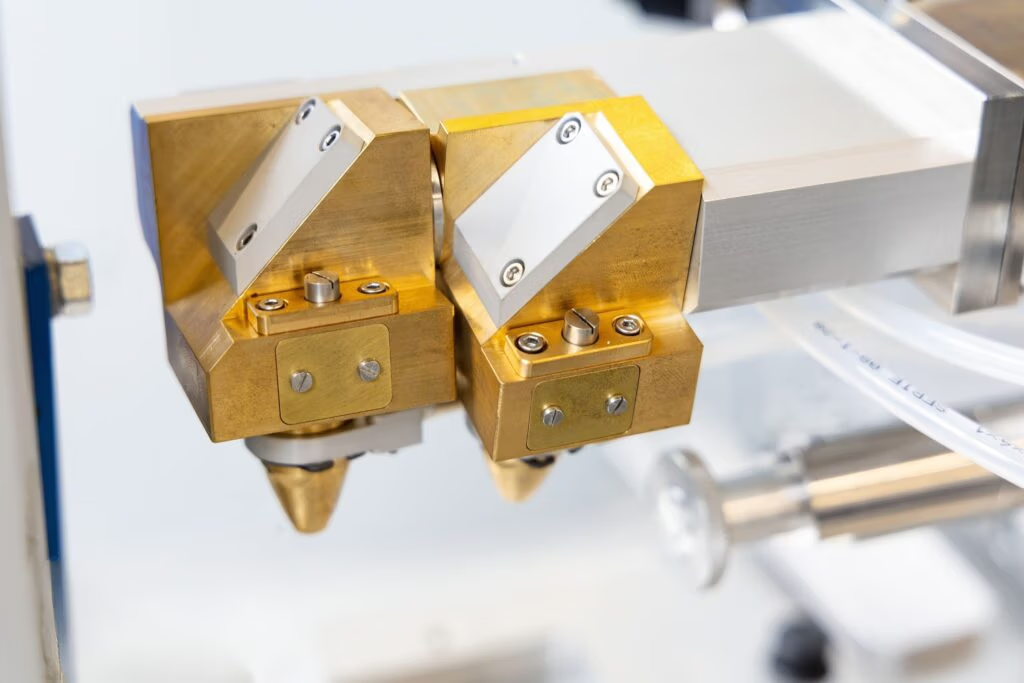
What is Laser Perforation?
Laser perforation is an industrial, non-contact process used to create precisely defined hole patterns, microperforations, and controlled tear lines in a wide range of materials. A focused laser beam selectively removes material or penetrates it completely with exceptional precision and repeatability.
Because the process is entirely contactless, it eliminates the mechanical wear associated with conventional methods such as needle perforation. Hole diameter, spacing, and perforation patterns can be adjusted with outstanding flexibility and accuracy to meet the specific requirements of each application.
Macro Perforation & Micro Perforation – What Is the Difference?
Both processes are based on the same laser technology but differ significantly in hole size, function, and typical applications.
Macro perforation
Macro perforation creates relatively large openings that are usually visible to the naked eye. It is used wherever controlled exchange of air, gas, or moisture is required.
Micro perforation
Microperforation creates ultra-fine holes in the micrometer range that are virtually invisible to the naked eye. It is used wherever precise control of gas exchange and moisture regulation is essential for preserving highly sensitive products such as fresh lettuce and asparagus.
Laser technology enables both variants to be produced with high precision, full repeatability, and seamless integration into inline production processes when required.
Which Materials are Suitable for Laser Perforation?
Metals & metal foils
Plastics & films
Paper & cardboard
Filter materials
Wood veneers & acoustic panels
Other materials
Benefits of Laser Perforation
Controllable and repeatable hole patterns
Non contact and wear free processing
High processing speed
Minimal heat affected zone
Learn more ➔
Optimized laser parameters ensure gentle processing, even for thin and heat sensitive materials.
Controlled permeability
Learn more ➔
Micro perforations allow precise control of gas, air, or liquid permeability.
Typical Laser Perforation Applications





Laser Perforation Solutions from MLT
If a material is suitable for laser perforation, we can provide the right machine solution. Our portfolio includes both standard systems and fully customized laser solutions designed for specific industrial requirements.
Our systems are used worldwide in packaging, filtration, battery production, technical films, and a wide range of specialized applications.
We support you in selecting the optimal laser source and system configuration from feasibility studies through to series production.
Frequently Asked Questions (FAQs)
What is the difference between laser perforation and mechanical perforation?
Laser perforation is a non-contact, tool-free process that eliminates mechanical wear and delivers significantly higher precision. Hole size, shape, and density can be digitally adjusted with maximum flexibility – even inline during production – enabling fast changeovers and consistent, high-quality results.
What are the advantages of laser perforation compared to die based perforation?
Laser perforation offers major advantages over mechanical methods. Perforation patterns including hole size, shape, and spacing can be adjusted simply by changing process parameters. Hole position, diameter, and spacing remain highly accurate and repeatable without any tool changes.
In addition, contact free processing is particularly beneficial for sensitive applications such as food packaging. Thanks to proprietary beam guidance systems and specialized laser sources, MLT machines achieve maximum precision even at very high production speeds.
What hole sizes are possible with laser perforation?
Depending on material, laser source, and process parameters, both macro perforations and micro perforations in the micrometer range can be achieved. Most applications use hole diameters between 40 micrometers and 800 micrometers. Other ranges are also possible depending on the application.
Is laser perforation suitable for roll to roll and continuous processes?
Yes. Laser perforation is ideally suited for web based materials and can be easily integrated into existing production lines, even at high line speeds and large volumes.
Can laser perforation be integrated inline into existing systems?
MLT laser perforation systems are available both as stand alone machines and for seamless inline integration into existing production equipment.
Which materials are best suited for laser micro perforation?
Typical materials include plastic films, multilayer composites, paper, nonwoven materials, filter media, and metal or battery foils. Even sensitive materials can be processed due to the minimal heat affected zone.
How repeatable is laser perforation in high volume production?
Laser perforation offers excellent process stability and repeatability. Perforation patterns and parameters remain consistent even in large production runs.
Is laser perforation economically viable?
Yes. The tool free and wear free process, minimal setup times, and high production speeds make laser perforation more economical than mechanical methods in many applications, especially for variable patterns or frequent product changes.
Does MLT support feasibility studies and testing?
Yes. MLT supports customers from feasibility analysis and sample production through to full scale production systems, ensuring that every solution is optimized for material, product, and process.
What production speeds can MLT systems achieve for laser perforation?
MLT systems achieve very high speeds in micro perforation applications. Depending on material and configuration, web speeds of up to 750 meters per minute and more than 1,000,000 holes per second can be reached. We are happy to evaluate the potential for your specific application.
Which laser sources and power levels are used in MLT laser perforation systems?
CO₂ lasers are typically used in combination with proprietary beam delivery systems. For metal foils, fiber lasers are commonly applied. Laser power ranges from 30 watts up to 4,000 watts per source, depending on the application requirements.